Kimi Antonelli and Titanium Dioxide: A Quantitative Analysis
This paper is available for download as a PDF. It might look more convincing.
Abstract
#Over the 2025 Formula One season, Andrea Kimi Antonelli, a driver for Mercedes-AMG Petronas Formula One Team, was observed to perform better in jurisdictions where titanium dioxide is a legal food additive. Using finishing position data for Grands Prix (including sprints) during the 2025 season, we found that Kimi Antonelli does finish significantly higher in races held in jurisdictions where titanium dioxide is a legal food additive; this effect is statistically significant both before and after normalization against the average constructor performance for Mercedes across Grands Prix. However, we did not find any statistical correlation between Antonelli’s fastest lap time during qualifying and titanium dioxide’s legal status, regardless of normalization against the team average. In addition, Antonelli’s generally lackluster performance at races situated in Europe, combined with the European Union’s ban on the use of titanium dioxide as a food additive, suggests that there may be other confounding variables involved in this correlational relationship.
Introduction
#Andrea Kimi Antonelli is an Italian racing driver who has been competing in Formula One for Mercedes-AMG Petronas Formula One Team since the 2025 season and is currently the championship leader for the 2026 season. As the first race this year in a jurisdiction that does not allow the use of titanium dioxide as a food additive, the Monaco Grand Prix, draws ever closer, it was of great interest to us to review one of the myths that had been circulating during last year’s season: whether Kimi Antonelli performs better at races in jurisdictions where it is legally allowed for titanium dioxide to be used as a food additive.
Methodology
#Using data from various sources, we compiled a comprehensive dataset of the 24 Grands Prix held over the 2025 Formula One season (6 of which included sprints, for a total of 30 races). The dataset includes the legal status of titanium dioxide as a food additive in each of the jurisdictions the Grands Prix were held in, the finishing positions of Kimi Antonelli and George Russell in each race, and whether the race was held in the European Union (in which titanium dioxide is not allowed to be used as a food additive). Titanium dioxide’s legal status in Azerbaijan was unclear at the time of writing, so it is labelled as 0.5; DNFs are attributed a finishing position of 21 for ease of comparison.
Table 1
| race | tio2 | antonelli | russell |
|---|---|---|---|
| AUS | 1 | 4 | 3 |
| CHN | 1 | 6 | 3 |
| CHN-S | 1 | 7 | 4 |
| JPN | 1 | 6 | 5 |
| BHR | 0 | 11 | 2 |
| SAU | 0 | 6 | 5 |
| MIA | 1 | 6 | 3 |
| MIA-S | 1 | 7 | 4 |
| EMI | 0 | 21 | 7 |
| MON | 0 | 18 | 11 |
| ESP | 0 | 21 | 4 |
| CAN | 1 | 3 | 1 |
| AUT | 0 | 21 | 5 |
| GBR | 1 | 21 | 10 |
| BEL | 0 | 16 | 5 |
| BEL-S | 0 | 17 | 12 |
| HUN | 0 | 10 | 3 |
| NED | 0 | 16 | 4 |
| ITA | 0 | 9 | 5 |
| AZE | 0.5 | 4 | 2 |
| SIN | 1 | 5 | 1 |
| USA | 1 | 13 | 6 |
| USA-S | 1 | 8 | 2 |
| MXC | 1 | 6 | 7 |
| SAP | 1 | 2 | 4 |
| SAP-S | 1 | 2 | 3 |
| LVG | 1 | 3 | 2 |
| QAT | 0 | 5 | 6 |
| QAT-S | 0 | 6 | 2 |
| ABU | 0 | 15 | 5 |
We also collected data on the fastest laps put in by Antonelli and Russell, as well as the pole lap, for each race during the 2025 Formula One season. The data are in units of milliseconds.
Table 2
| race | antonelli_quali | russell_quali | pole_quali |
|---|---|---|---|
| AUS | 76525 | 75546 | 75096 |
| CHN | 91103 | 90723 | 90641 |
| CHN-S | 91738 | 91169 | 90849 |
| JPN | 87555 | 87318 | 86983 |
| BHR | 90213 | 90009 | 89841 |
| SAU | 87866 | 87407 | 87294 |
| MIA | 86271 | 86385 | 86204 |
| MIA-S | 86482 | 86791 | 86482 |
| EMI | 75772 | 74807 | 74670 |
| MON | 71880 | 71507 | 69954 |
| ESP | 72111 | 71848 | 71546 |
| CAN | 71391 | 70899 | 70899 |
| AUT | 65276 | 64763 | 63971 |
| GBR | 85374 | 85029 | 84892 |
| BEL | 102139 | 101260 | 100562 |
| BEL-S | 105394 | 102330 | 100510 |
| HUN | 76386 | 75425 | 75372 |
| NED | 69493 | 69255 | 68662 |
| ITA | 79200 | 79157 | 78792 |
| AZE | 101717 | 102070 | 101117 |
| SIN | 89537 | 89158 | 89158 |
| USA | 93114 | 92826 | 92510 |
| USA-S | 94018 | 92888 | 92143 |
| MXC | 76118 | 76034 | 75586 |
| SAP | 69685 | 69942 | 69511 |
| SAP-S | 69340 | 69495 | 69243 |
| LVG | 116314 | 108803 | 107934 |
| QAT | 79846 | 79662 | 79387 |
| QAT-S | 80532 | 80087 | 80055 |
| ABU | 83080 | 82645 | 82207 |
In order to measure the effects of additional confounding variables, we also included in the dataset whether races took place inside the European Union, where titanium dioxide as a food additive is banned.
Table 3
| race | is_european_union |
|---|---|
| AUS | 0 |
| CHN | 0 |
| CHN-S | 0 |
| JPN | 0 |
| BHR | 0 |
| SAU | 0 |
| MIA | 0 |
| MIA-S | 0 |
| EMI | 1 |
| MON | 0 |
| ESP | 1 |
| CAN | 0 |
| AUT | 1 |
| GBR | 0 |
| BEL | 1 |
| BEL-S | 1 |
| HUN | 1 |
| NED | 1 |
| ITA | 1 |
| AZE | 0 |
| SIN | 0 |
| USA | 0 |
| USA-S | 0 |
| MXC | 0 |
| SAP | 0 |
| SAP-S | 0 |
| LVG | 0 |
| QAT | 0 |
| QAT-S | 0 |
| ABU | 0 |
Results
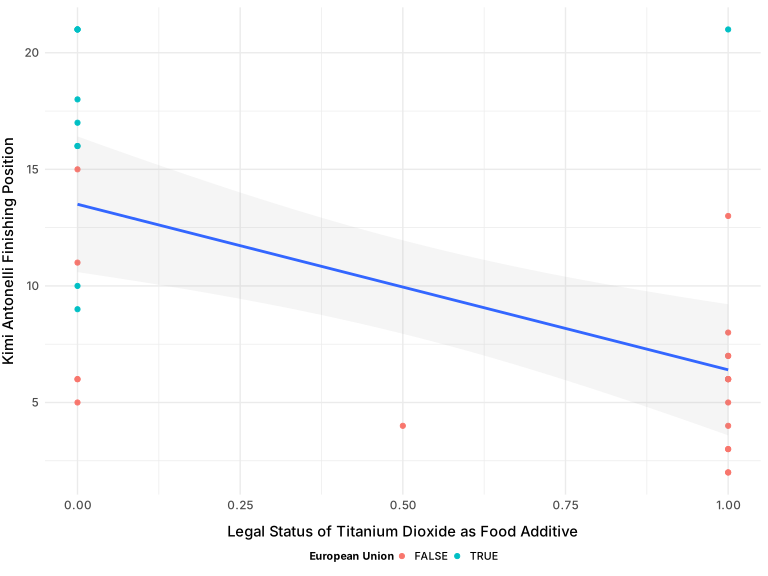
#Given this data, we fit a linear model against the relationship between Kimi Antonelli’s finishing position and the legal status of titanium dioxide as a food additive.
| Dependent variable: antonelli | |
|---|---|
| tio2 | -7.100*** (1.993) |
| Constant | 13.502*** (1.421) |
| Observations | 30 |
| R2 | 0.312 |
| Adjusted R2 | 0.287 |
| Residual Std. Error | 5.362 (df = 28) |
| F Statistic | 12.696*** (df = 1; 28) |
| Note: | *p<0.1; **p<0.05; ***p<0.01 |
We found that Kimi Antonelli’s finishing position in races during the 2025 Formula One season is strongly and negatively correlated against the legal status of titanium dioxide as a food additive, with a significance level of p<0.01.
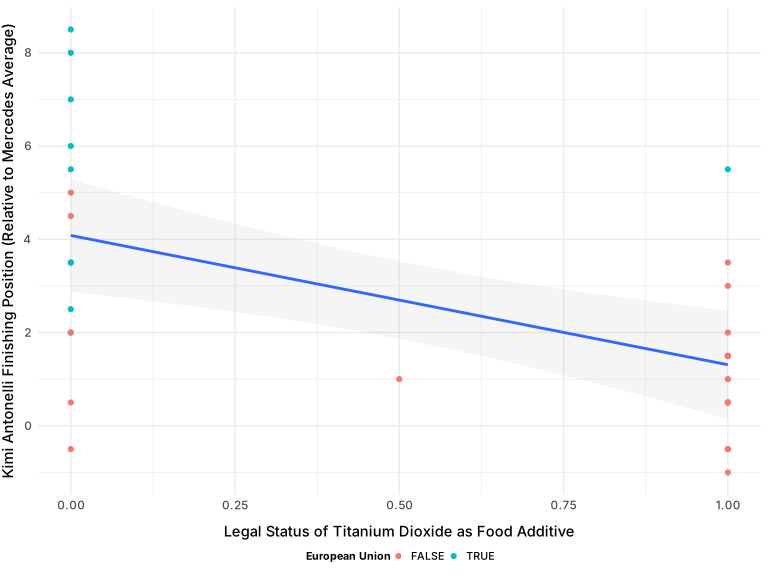
In order to account for general differences in constructor performance across different circuits, we also normalized Antonelli’s finishing position against the overall team performance for Mercedes across circuits by calculating the delta between Antonelli’s finishing position and the average of Antonelli’s and Russell’s finishing positions (i.e. antonelli - ((antonelli + russell) / 2)).
| Dependent variable: antonelli_norm | |
|---|---|
| tio2 | -2.772*** (0.826) |
| Constant | 4.082*** (0.589) |
| Observations | 30 |
| R2 | 0.287 |
| Adjusted R2 | 0.261 |
| Residual Std. Error | 2.223 (df = 28) |
| F Statistic | 11.257*** (df = 1; 28) |
| Note: | *p<0.1; **p<0.05; ***p<0.01 |
Again, we found that Kimi Antonelli’s finishing position in races, even when normalized against Mercedes’ team performance as a whole, is strongly and negatively correlated against titanium dioxide’s legal status as a food additive, with a significance level of p<0.01.
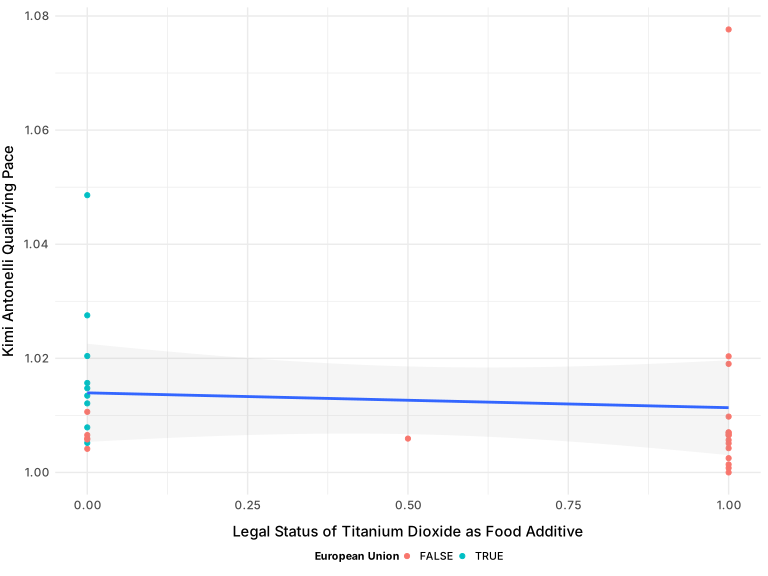
Rather than using the qualifying position as an indicator of raw pace, as some prior literature on this topic has done, we chose to use fastest lap time during qualifying as a proportion of pole lap time as a better indicator of relative pace. Qualifying position itself is a data point that, in our view, is already reflected in race finishing position. However, it is to be noted that due to differing tyre allocations during different parts of qualifying and track evolution, it may not be on the whole completely appropriate to compare the fastest lap for a particular driver with the fastest lap overall in the context of a qualifying session.
| Dependent variable: antonelli_quali/pole_quali | |
|---|---|
| tio2 | -0.003 (0.006) |
| Constant | 1.014*** (0.004) |
| Observations | 30 |
| R2 | 0.007 |
| Adjusted R2 | -0.029 |
| Residual Std. Error | 0.016 (df = 28) |
| F Statistic | 0.195 (df = 1; 28) |
| Note: | *p<0.1; **p<0.05; ***p<0.01 |
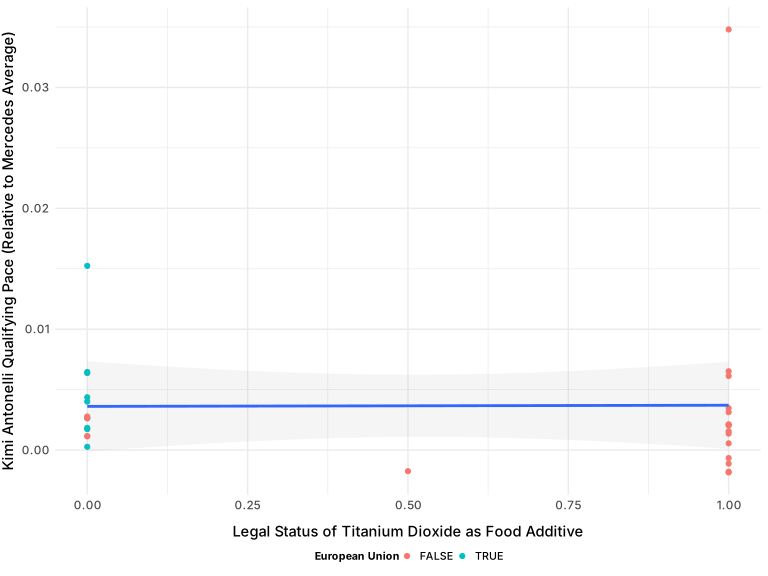
Counter to our expectations, Antonelli’s qualifying pace did not have any statistically significant correlation with the legal status of titanium dioxide as a food additive. We then normalized this qualifying pace data against the average for Mercedes (i.e. (antonelli_quali / pole_quali) - (((antonelli_quali / pole_quali) + (russell_quali / pole_quali)) / 2)).
| Dependent variable: antonelli_quali_norm | |
|---|---|
| tio2 | 0.0001 (0.003) |
| Constant | 0.004* (0.002) |
| Observations | 30 |
| R2 | 0.00005 |
| Adjusted R2 | -0.036 |
| Residual Std. Error | 0.007 (df = 28) |
| F Statistic | 0.001 (df = 1; 28) |
| Note: | *p<0.1; **p<0.05; ***p<0.01 |
After normalization, we still did not find any statistically significant relationship between Antonelli’s qualifying pace and the legal status of titanium dioxide as a food additive. These conclusions suggested to us that, if there was any causal relationship between Kimi Antonelli’s performance during Formula One sessions and whether titanium dioxide was legally allowed as a food additive, it was restricted to race pace only and not qualifying pace.
Recognizing the fact that Kimi Antonelli generally did not perform particularly well at the European races during the 2025 season compared to his overall performance throughout the year, and the fact that the European Union, which includes many of the jurisdictions the European races were held in, has a blanket ban on the use of titanium dioxide as a food additive, we considered being in the European Union a confounding variable in the relationship between Antonelli’s F1 performance and titanium dioxide’s legal status.
| Dependent variable: antonelli | Dependent variable: tio2 | |
|---|---|---|
| is_european_union | 8.920*** (2.069) | -0.705*** (0.162) |
| Constant | 7.455*** (1.069) | 0.705*** (0.084) |
| Observations | 30 | 30 |
| R2 | 0.399 | 0.402 |
| Adjusted R2 | 0.377 | 0.381 |
| Residual Std. Error | 5.012 (df = 28) | 0.393 (df = 28) |
| F Statistic | 18.585*** (df = 1; 28) | 18.833*** (df = 1; 28) |
| Note: | *p<0.1; **p<0.05; ***p<0.01 |
Conducting linear model fitting for both of these variables against membership of the EU, we found that both Antonelli’s performance and the legal status of titanium dioxide had a statistically significant relationship with EU membership. It is possible, therefore, that there are other causes that could explain Antonelli’s relative poor performance in Europe during the middle part of the 2025 season that are not related to titanium dioxide not being allowed as a food additive, including specific circuit characteristics and Antonelli’s own ongoing development as a Formula One driver.
Conclusion
#Using data on finishing positions and qualifying lap times during the 2025 Formula One World Championship as provided by the FIA and conducting linear model regressions against the legal status of titanium dioxide as a food additive, we found that Antonelli finished in statistically higher positions at races taking place in jurisdictions where the use of titanium dioxide as a food additive was legally allowed, both before and after normalization for average constructor performance across circuits. We did not, however, find any statistically significant relationship between Antonelli’s qualifying pace and the legal status of titanium dioxide regardless of normalization. If culinary use of titanium dioxide was causally linked to Antonelli’s racing performance, it is only race pace and not qualifying pace that is affected. In addition, it is possible that other factors may be able to explain Antonelli’s poor performance in Europe during the 2025 season that are unrelated to titanium dioxide’s legal status, due to the confounding effect of the EU’s general ban on the use of titanium dioxide as an additive.
Recommendations
#Despite the uncertainty surrounding the causality between the use of titanium dioxide as a food additive and Antonelli’s racing performance in F1, due to the non-zero possibility of Oscar Piastri, a highly talented driver racing for McLaren Mastercard F1 Team, making a miraculous comeback in the remainder of the 2026 season and winning his first WDC against all odds, it is our recommendation that Mercedes-AMG Petronas Formula One Team supply Kimi Antonelli with a titanium dioxide-heavy diet if they wish to secure the 2026 World Drivers’ Championship for Antonelli.
Further research on this topic should consider expanding the dataset to include drivers from other teams as well and possibly conducting a controlled dietary experiment, which would result in more credible results and recommendations to drivers and constructors on how to best adjust for titanium dioxide availability across different races. It may also be beneficial for the FIA to look into banning titanium dioxide intake for drivers as part of the new set of regulations introduced in 2026 in order to ensure fairness and improve racing, if there are further studies that justify doing so.